If you've chosen to buy a Flat Coated Retriever then congratulations! You won't regret it - they make great loyal companions, full of energy, life, affection and vigour. Their enthusiasm and optimism is so infectious and will brighten up your every day. Before choosing your dog a few health and breeder checks will help you in your decision:
For free dog food, free clicker trainer, free puppy food sample and other dog freebies visit the flat-coats.co.uk Free Dog Food page.
CHOOSING A BREED OF DOG
Owning a dog is a lifetime commitment so please do give plenty of thought before buying a dog. Choose the right breed for you and your family and you'll all be rewarded with a lifetime of love and happiness. The average dog lives for 12 years with some breeds living up to 17 years.
It'll help you in your choice to answer the following questions:
Is your house big enough for the breed of dog you'd like?
Have you a garden or access to a grassed area where your dog can toilet?
Will you, or other family members be at home to look after the dog?
Can you afford the expense of a large dog that will need a high energy diet?
Do you want a guard dog or a companion?
Has anyone in the home any allergies? Do you need to choose a short-coated dog?
Will you have enough space for a large or small dog basket in your house?
Do you need to choose a dog that is tolerant of children?
Do you want a male or female dog? Males can be more dominant and prone to wandering off. Females will come on heat twice a year, which results in vaginal discharge, which will make a mess around your home, unless you choose to neuter the dog.
Whilst my four legged companion sat beside me I wrote a book which tells the story of The Grey Lady Ghost of the Cambridge Military Hospital which reveals her origins in the QAIMNS and where she meets a QA veteran of Afghanistan. She still walks her wards and tells her story by taking Scott Grey, a QARANC nurse, to the battlefields of World War One and beyond. This is the first in the series of Grey and Scarlet Novels by CG Buswell. Read the first chapter for free.
Over £100,000 of vouchers to be won - everyone's a winner!
Flat Coated Retrievers Book
Flat-Coated Retriever (Comprehensive Owner's Guide) is a detailed flat coated retrievers book, published by Kennel Club Books, which will prove useful to any owner. Chapters include the history of the Flat Coat dog, advice on choosing a puppy, health care and training tips.
Buy Now.
If you would like to add your text, image, product, service, website or photo to this flat-coats page then please .
WHERE TO BUY A DOG
Depending on your budget you could buy a puppy from a recognised breeder to guarantee pedigree. Alternatively, you may wish to buy a dog or puppy from a recognised animal welfare organisation such as the RSPCA. I would not recommend buying a dog/puppy from any other source.
Puppies from recognised breeders will cost in the hundreds of pounds - but you will get a pedigree certificate, ancestral history and a pure bred puppy.
Animal welfare organisations do occasionally receive pedigree dogs to re-home, perhaps when their owner has died or is too infirm to care for the dog. You'll also find a range of mongrel dogs and puppies, which can become loyal and obedient pets and may avoid certain health problems that are inherent in pedigrees. Most animal welfare organisations will neuter their dogs before re-homing them and have strict re-homing criteria, which often include a check of your home to gauge suitability. A donation is often required or requested, which goes towards their expensive running costs.
CHOOSING A DOG OR PUPPY
Never be tempted to buy the runt of the litter because it looks cute - you're just asking for trouble - either behaviourally or with health problems. Instead, watch the litter interact with each other and with the mother. Choose a lively inquisitive puppy. If you will not be showing your dog in the future and you choose a puppy that has incorrect coloration or markings you could negotiate a discount with the breeder as no-one will want to buy the dog for show purposes and they will usually be pleased to have sold the puppy, reserving the aesthetically pleasing dogs for a higher price for enthusiasts. This doesn't mean you get an inferior puppy - but do avoid puppies that have obvious deformities.
Observe the kennel area for stools - the puppies and mother's faeces should be firm. Loose, runny stools could be an indication of digestive troubles.
When the puppies go to feed, look for a puppy that confidently feeds from the mother - this should remain a confident dog - avoid puppies that nervously feed.
Avoid buying a puppy or dog that shows signs of fleas - search amongst the coat to the skin folds and look for small black fleas. The coats should shine and appear full with no bald patches. The eyes should be alert and bright and the ears should have no unpleasant smell or discharge. Feel under the tummy of the dog or puppy searching for any lumps, which could be a hernia. Walk the dog or puppy around observing for any lameness. They should appear sleek but not undernourished where you can see the ribs, though you should be able to feel them with no difficulty. A puppy that has a potbelly could well have worms.
You can usually choose your puppy from 5 weeks old, and collect them when they are 8 or 9 weeks old.
You may wish to read the Training Tips Section - early training will help you form a close relationship with your dog who will learn to obey your commands and be a valuable part of the family. Reading the Puppy Care Sections will be beneficial to settling your puppy in to its new home. Please do consider buying puppy and dog insurance.
The Dog Poop Disposal page gives advice on how to get rid of your dog poo safely and hygienically.
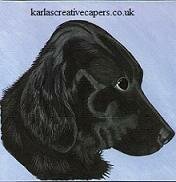
Free UK Delivery on Pet Portraits from photographs at Karla's Creative Capers who did the portrait on the left from a photo of my Lucy. The portraits are ready to hang on the wall and are of a high quality canvas. For full details see www.karlascreativecapers.co.uk
Custom Search
Site contents copyright Flat-Coats.co.uk - All rights reserved.



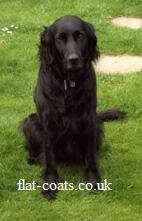 Owning a dog is a lifetime commitment so please do give plenty of thought before buying a dog. Choose the right breed for you and your family and you'll all be rewarded with a lifetime of love and happiness. The average dog lives for 12 years with some breeds living up to 17 years.
 Whilst my four legged companion sat beside me I wrote a book which tells the story of The Grey Lady Ghost of the Cambridge Military Hospital which reveals her origins in the QAIMNS and where she meets a QA veteran of Afghanistan. She still walks her wards and tells her story by taking Scott Grey, a QARANC nurse, to the battlefields of World War One and beyond. This is the first in the series of Grey and Scarlet Novels by CG Buswell. Read the first chapter for free.
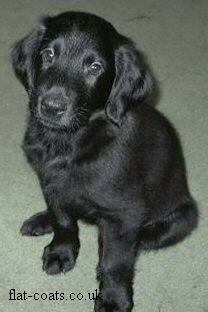 Depending on your budget you could buy a puppy from a recognised breeder to guarantee pedigree. Alternatively, you may wish to buy a dog or puppy from a recognised animal welfare organisation such as the RSPCA. I would not recommend buying a dog/puppy from any other source.
 Never be tempted to buy the runt of the litter because it looks cute - you're just asking for trouble - either behaviourally or with health problems. Instead, watch the litter interact with each other and with the mother. Choose a lively inquisitive puppy. If you will not be showing your dog in the future and you choose a puppy that has incorrect coloration or markings you could negotiate a discount with the breeder as no-one will want to buy the dog for show purposes and they will usually be pleased to have sold the puppy, reserving the aesthetically pleasing dogs for a higher price for enthusiasts. This doesn't mean you get an inferior puppy - but do avoid puppies that have obvious deformities.