Home
FlatCoated Retriever Breed Standard
Buying a Dog or a Puppy
Buy Food and Products

Buy A Flat Coated Retriever
Caring for Your Puppy
Clicker Training a Dog
Cushing's Disease
Dietary Advice
Calendar
Cancer
Ear Care
Eating Faeces
Foods To Avoid
Dog Friendly Garden
Gift Box
Insurance
Poop Disposal
Teeth Care
Toys
Websites
Will
Epilepsy
Free Food
Get your Dog on TV or Magazines
Grass Eating
Grooming
Health
Hip Dysplasia
History
How To Cut Nails
How To Deal With Hair
How To Give A Bath
How to stop Barking
How To Teach Roll Over and Play Dead
How to tell if your Dog is Overweight
How To Work Out A Dogs Age
Introducing a New Puppy to an Older Dog
I would love the site to grow and would be grateful for a few seconds of your time to achieve this. Please help share this page:
Tweet
Kennel Cough Symptoms
Links
Mange Signs
Privacy/Disclaimer Policy
Puppy Training Tips
Signs of Arthritis
Signs of Dehydration
Signs of Worms
Site Map
Signs of Pain
Training to the Whistle Come Back
Why Dogs Go Round In Circles Before Lying Down
|
|
Before we discuss signs of worms in dogs we will start with a general health care for dogs.
The flat-coats ideal weight is 25 - 34 kg for female dogs and 25 - 35 kg for male dogs. Most male dogs will reach a height of 58 -61 cm whilst female dogs will reach between 56 - 59 cm.
The average lifespan of a flat coated retriever is 12 years.
You should get your new dog/puppy registered at a veterinary surgery and checked over by the vet. The vet can then advise you about vaccinations, worming and general care of your dog. It should be vaccinated against distemper, infectious canine hepatitis, leptospirosis and parvovirus, with annual vaccinations after the initial course.
Fleas In Dogs
Persistent scratching and self biting, especially at the base of the tail could be a sign of fleas in your dog. Grooming your dog outside with a flea comb will help detect the parasites. Treatment varies from shampoos, collars, powders and special chemicals that are dropped onto the dog's coat. Pet Planet have a range of up to date flea treatments. Do also remember to clean the dog's basket and wash their bedding and vaccum the carpets to remove any flea eggs
  Whilst my four legged companion sat beside me I wrote a book which tells the story of The Grey Lady Ghost of the Cambridge Military Hospital which reveals her origins in the QAIMNS and where she meets a QA veteran of Afghanistan. She still walks her wards and tells her story by taking Scott Grey, a QARANC nurse, to the battlefields of World War One and beyond. This is the first in the series of Grey and Scarlet Novels by CG Buswell. Read the first chapter for free. Whilst my four legged companion sat beside me I wrote a book which tells the story of The Grey Lady Ghost of the Cambridge Military Hospital which reveals her origins in the QAIMNS and where she meets a QA veteran of Afghanistan. She still walks her wards and tells her story by taking Scott Grey, a QARANC nurse, to the battlefields of World War One and beyond. This is the first in the series of Grey and Scarlet Novels by CG Buswell. Read the first chapter for free.
Over £100,000 of vouchers to be won - everyone's a winner!
Flat Coated Retrievers Book
Flat-Coated Retriever (Comprehensive Owner's Guide) is a detailed flat coated retrievers book, published by Kennel Club Books, which will prove useful to any owner. Chapters include the history of the Flat Coat dog, advice on choosing a puppy, health care and training tips.
Buy Now.
If you would like to add your text, image, product, service, website or photo to this flat-coats page then please .
Ticks In Dogs
Ticks are usually found in rural areas where sheep are found. The ticks can be picked up onto the dog's coat as it runs around the undergrowth. The tick adheres to the skin of the dog and sucks the blood, swelling to as large as 1cm. During this blood sucking the tick can transfer protozoal diseases, so early removal is essential. most ticks can be removed by dabbing the area with cottonwool soaked with methylated spirit which should loosen their grip. Then they can be removed with tweezers. Antiseptic cream can be applied to the area incase the tick's jaws have been left in the skin.
Worms In Dogs
The most common worms are tapeworms and roundworms:
Tapeworms are flat and ribbon like and attach their heads to the dog's gut wall whilst the body is passed out in the dog's stool. Preventative three monthly de-worming is recommended for adult dogs, though pregnant and nursing dogs should be wormed more frequently. Puppies are normally wormed every 2 - 3 weeks until they are 3 months old, then wormed monthly until they are 6 months old, then treated as adult dogs.
Roundworms (Toxocara canis) live in the dog's intestines and continually shed eggs. Preventative twice yearly de-worming is recommended. The larvae can move around the body to other organs such as the liver. These type of worms can infect humans.
Signs Of Worms In Dogs
Weight loss or being underweight
Unhealthy coat and skin which looks dull
Hunger
Vomiting
Diarrhoea
Worms appear in the faeces or vomit of the dog
Tapeworm eggs may look like white rice clinging to the anus of the dog
Lethargy
Click the links below to learn more about these dog conditions and health problems:
Canine Arthritis
Dog Cancer
Ear Care
Epilepsy
Hip Dysplasia
Kennel Cough
Mange
Nail Care
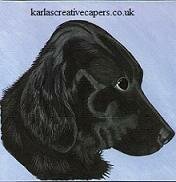
Free UK Delivery on Pet Portraits from photographs at Karla's Creative Capers who did the portrait on the left from a photo of my Lucy. The portraits are ready to hang on the wall and are of a high quality canvas. For full details see www.karlascreativecapers.co.uk
|


