Home
FlatCoated Retriever Breed Standard
Buying a Dog or a Puppy
Buy Food and Products
Buy A Flat Coated Retriever
Caring for Your Puppy
Clicker Training a Dog
Cushing's Disease
Dietary Advice
Calendar
Cancer
Ear Care
Eating Faeces
Foods To Avoid
Dog Friendly Garden
Gift Box
Insurance
Poop Disposal
Teeth Care
Toys
Websites
Will
Epilepsy
Free Food
Get your Dog on TV or Magazines
Grass Eating
Grooming
Health
Hip Dysplasia
History
How To Cut Nails
How To Deal With Hair
How To Give A Bath
How to stop Barking
How To Teach Roll Over and Play Dead
How to tell if your Dog is Overweight
How To Work Out A Dogs Age
Introducing a New Puppy to an Older Dog
I would love the site to grow and would be grateful for a few seconds of your time to achieve this. Please help share this page:
Tweet
Kennel Cough Symptoms
Links
Mange Signs
Privacy/Disclaimer Policy
Puppy Training Tips
Signs of Arthritis
Signs of Dehydration
Signs of Worms
Site Map
Signs of Pain
Training to the Whistle Come Back
Why Dogs Go Round In Circles Before Lying Down
|
|
THE HISTORY OF CLICKER TRAINING
The foundations for clicker training a dog go back to the nineteenth century work by Russian physiologist Ivan Pavlov during training of animals for military use. He later extended his work in civilian life to the training of animal actors and marine mammals. It wasn't until the mid 1980's work by mammal trainer Karen Pryor that dog trainers discovered the positive use of clicker training a dog. Because clicker training does not use punishment nor corrective training, but works on positiveness its popularity rose amongst dog trainers and owners to teach obedience amongst working and domestic dogs. Clicker training a dog is also used to teach agility, tricks and to overcome problem behaviour and to re-educate older dogs.
  Whilst my four legged companion sat beside me I wrote a book which tells the story of The Grey Lady Ghost of the Cambridge Military Hospital which reveals her origins in the QAIMNS and where she meets a QA veteran of Afghanistan. She still walks her wards and tells her story by taking Scott Grey, a QARANC nurse, to the battlefields of World War One and beyond. This is the first in the series of Grey and Scarlet Novels by CG Buswell. Read the first chapter for free. Whilst my four legged companion sat beside me I wrote a book which tells the story of The Grey Lady Ghost of the Cambridge Military Hospital which reveals her origins in the QAIMNS and where she meets a QA veteran of Afghanistan. She still walks her wards and tells her story by taking Scott Grey, a QARANC nurse, to the battlefields of World War One and beyond. This is the first in the series of Grey and Scarlet Novels by CG Buswell. Read the first chapter for free.
Over £100,000 of vouchers to be won - everyone's a winner!
Flat Coated Retrievers Book
Flat-Coated Retriever (Comprehensive Owner's Guide) is a detailed flat coated retrievers book, published by Kennel Club Books, which will prove useful to any owner. Chapters include the history of the Flat Coat dog, advice on choosing a puppy, health care and training tips.
Buy Now.
If you would like to add your text, image, product, service, website or photo to this flat-coats page then please .
WHAT IS A DOG CLICKER
The dog clicker itself is nothing terribly scientific, though the rationale behind it is. It can take many forms, but most commonly a dog clicker is a small plastic box, that fits easily into the owner's or trainer's hand, with a small metal button inside which makes a distinctive noise when clicked.
HOW DOES DOG CLICKER TRAINING WORK
When clicker training a dog it is important to not use a cue or verbal label until the dog has learned the new behaviour and can perform it consistently. This then prevents half formed behaviour (cited in 100 Ways to Train the Perfect Dog).
By following the recommended training plans the dog will soon recognise receiving a reward, usually a food treat, with particular actions. This means your dog will be more attuned to the positive training whilst making its training fun and stimulating without any negative and damaging corrective punishment. Clicker training a dog rewards the actions you want and ignores the actions you do not want.
When giving your dog a treat or food reward during clicker training this should be given a few moments after the click so that the dog learns to associate the clicker sound with the acceptable behaviour.
Please do remember that puppies and dogs have acute hearing and the sound of the dog clicker will be loud and painful if you click to their ear. The clicker should be clicked a little distance from them to prevent any pain or distraction and provide you with more comfort in not having to stoop each time.
Clicker training a dog need only be used when introducing a new command or training routine, then can be gradually phased out. It can be re-introduced at any time if a dog forgets the command action or gets a bit lazy. It can also be introduced to older dogs to teach them new or enforce existing commands.
The dog clicker should not be used to get the attention of your dog and should only be used reward or highlight a behaviour that you want the dog to repeat and learn.
The best way to describe clicker training a dog has been written in 100 Ways to Train the Perfect Dog by Sarah Fisher and Marie Miller when they say:
For example, if you are teaching your dog to sit, use food in your hand to lure the position, click as he sits and then reward. He will quickly learn to sit without the food lure.
Buy Clicker Training Books and a Dog Clicker:
I would recommend reading at least one of the clicker training a dog books below before commencing dog clicker training:
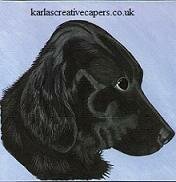
Free UK Delivery on Pet Portraits from photographs at Karla's Creative Capers who did the portrait on the left from a photo of my Lucy. The portraits are ready to hang on the wall and are of a high quality canvas. For full details see www.karlascreativecapers.co.uk
|


